top of page
Apna Ghar
Domestic space is often understood as a reflection of social difference—caste hierarchies, gender roles, class divisions, and bodily abilities are assumed to be inscribed into the plan of the house itself. However, the spatial configuration of my family home challenges this assumption. While the daily life within the house reveals unequal routines and responsibilities, the architectural layout does not enforce segregation or hierarchy. Instead, the house operates as a shared and neutral framework, within which difference emerges through lived practice rather than built form.
The house accommodates six members: my parents, two younger sisters, a younger brother, and my youngest sister who has limited mobility. Although I no longer live here, my understanding of the space is shaped by prolonged inhabitation and observation. The plan consists of a clearly defined entrance, a central living area, a kitchen placed as an active core, bedrooms arranged for privacy, and circulation spaces that connect all functions without thresholds of exclusion.
From the plan, it is evident that no space is designated or restricted by gender, age, or status. All rooms open into common circulation paths, allowing equal access to the kitchen, living space, and bedrooms. There is no physical separation between “public” and “private” realms within the house, except those created temporarily through use and time.
This openness becomes crucial in understanding how difference operates. The plan does not dictate who belongs where; instead, it allows movement to be shaped by routine, care, and necessity.

From the plan, it is evident that no space is designated or restricted by gender, age, or status. All rooms open into common circulation paths, allowing equal access to the kitchen, living space, and bedrooms. There is no physical separation between “public” and “private” realms within the house, except those created temporarily through use and time.
This openness becomes crucial in understanding how difference operates. The plan does not dictate who belongs where; instead, it allows movement to be shaped by routine, care, and necessity.
The kitchen, as shown in the plan, is one of the most connected spaces in the house. My mother spends most of her day here, cooking, preparing meals, and managing household routines. While this might appear as gendered confinement, the architecture itself tells a different story.
The kitchen is not pushed to the margins; it remains visually and spatially integrated with the rest of the house. My mother moves freely between the kitchen, bedrooms, and living area. Her prolonged presence in one space results from responsibility and care work, not architectural restriction. The plan enables movement; social roles define frequency.
My brother and one of my sisters attend school from 8 AM to 2 PM. Their movement follows a predictable cycle—departure through the main entrance, return to shared spaces like the living area and bedrooms. The plan allows them to occupy the same zones without distinction based on gender.
Another sister stays home after school hours, using the same rooms for studying, resting, and social interaction. No room is assigned as “male” or “female.” The bedrooms and living spaces become shared territories, reinforcing the idea that the house does not encode gender hierarchy.

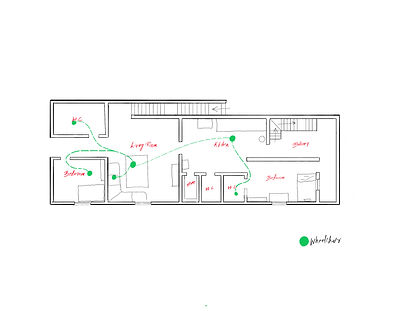
The youngest sister’s movement is the most spatially revealing. Due to her inability to walk, she either remains stationary or is moved by others using a wheelchair. Her primary locations—bedroom, living area, and kitchen for meals—are all accessible within the plan.
However, her movement depends entirely on human assistance rather than architectural adaptation. The house does not exclude her, but it does not actively enable independence either. Still, she is never spatially isolated. Her presence occupies the same central zones as others, emphasizing that difference here is bodily, not social or spatial.
Notably, the plan does not display markers often associated with caste or class segregation—no separate service entrances, no spatial purification zones, no hierarchical layering of rooms. Economic class influences daily routines (work, schooling, domestic labor) but does not translate into spatial inequality.
This suggests that the same architectural layout could produce very different gendered or caste-based behaviors under different belief systems. In this house, difference is negotiated socially rather than enforced architecturally.
The plan of this house reveals an important truth: architecture does not automatically produce difference. While daily life inside the house reflects unequal labor, caregiving responsibilities, and physical ability, the spatial configuration remains flexible, shared, and non-discriminatory.
Gender, class, caste, and disability shape how the house is used—but not who is allowed where. The same space accommodates varied bodies, routines, and roles without formal segregation. For this reason, no architectural changes seem necessary. The house is already gentrified—not by design aesthetics, but by adaptability and shared access.
Ultimately, the house becomes a canvas where difference is lived, not built.
bottom of page