From Raw Agashi Wood to a Working Drafting Table
Project Overview
This project was part of my Allied Course in Woodworking, where the objective was to design and fabricate a functional drafting table using raw wood. The process involved understanding material behavior, handcrafting structural joints, and solving for precision, stability, and adjustability through making.
Before beginning the physical fabrication, a 3D digital model of the drafting table was developed. This helped in understanding proportions, structural behavior, and the working of the adjustable mechanism. The model was used to test angles, joint positions, and movement before committing to the material.
A 1:50 scale physical model was then fabricated to study the joinery and movement in real space. This model helped identify issues that were not visible in the digital model, especially related to joint clearance, stability, and alignment. The learnings from this stage directly informed the final construction of the full-scale table.
Material – Agashi Wood
Agashi wood was used as the primary material. The wood was received in a raw, uneven condition, requiring extensive preparation before it could be assembled. Through this process, I developed an understanding of wood grain, surface behavior, and structural strength, which directly influenced the final design decisions.
Preparing the Wood
Manual planing and surface preparation using hand tools
The initial stage involved cleaning and leveling the wood by repeatedly planing (rande marna) and smoothing each member. This stage demanded patience and accuracy, as even small surface irregularities affected joint alignment later in the process.
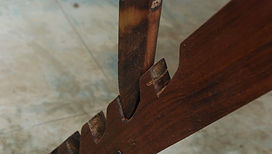
The Khacha
The most critical challenge of the project was designing and executing the khacha (joint system). It had to satisfy three conditions simultaneously:
-
Maintain a strict 90-degree alignment
-
Allow angular adjustment of the table surface
-
Enable height variation while remaining structurally stable
Achieving this balance between rigidity and movement became the core learning of the project.
Joinery & Adjustability
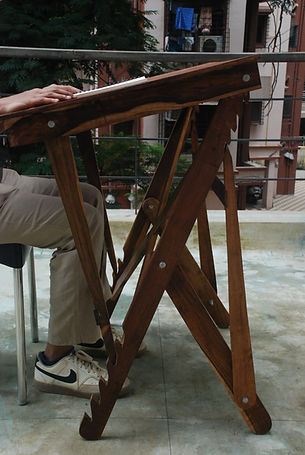
The joint system was developed through trial and error, with continuous checking of angles and tolerances. Precision in drilling and alignment was crucial, as minor deviations compromised the table’s stability. The final mechanism allows the table surface to be adjusted in both height and angle while maintaining structural integrity.
Tools & Techniques
-
Hand planer (Randa) – surface leveling
-
Chisel – joint detailing
-
Hammer & fasteners – assembly
-
Measuring tools – maintaining 90° accuracy
-
Clamps & drills – controlled fixing
Finishing & Polishing
After assembly, the table was polished using varnish to protect the wood and enhance the natural grain. The finishing process revealed the craftsmanship of the joints and gave the table a durable, refined surface suitable for daily use.
Final Outcome
The final drafting table is a functional, adjustable piece of furniture designed and fabricated entirely from raw wood. Beyond the object itself, the project strengthened my understanding of material behavior, structural logic, and precision—skills that directly translate into architectural thinking and construction detailing.


.jpeg)


.jpeg)